Edibles are already big
$19B -> $52B+
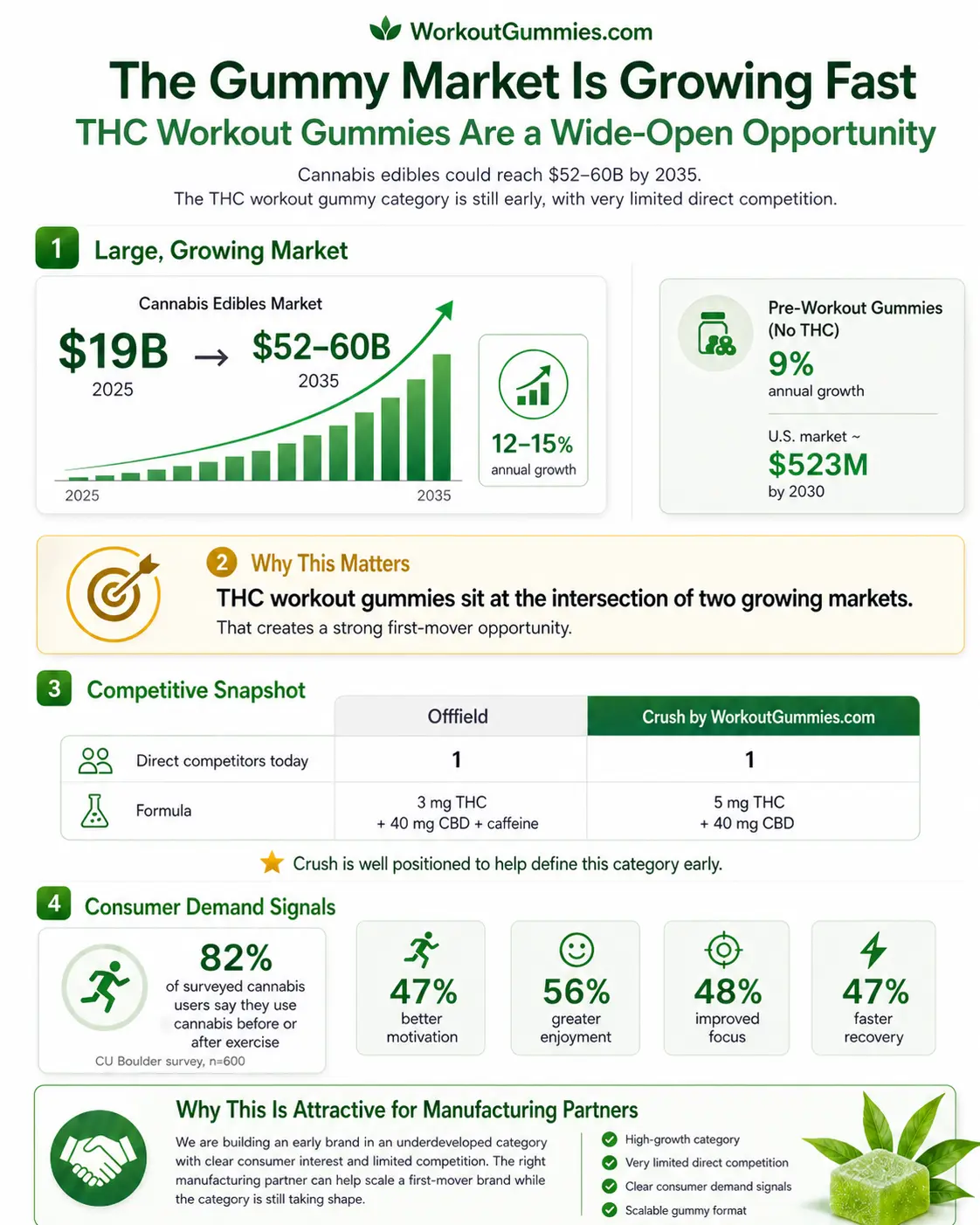
Cannabis edibles were estimated near $19B in 2025 and projected above $52B by 2034; another industry forecast points to roughly $60B by 2035.

The Path Forward | May 2026
Vermont Forest is seeking strategic growers and manufacturing partners to build a vertically integrated national brand around Crush - Workout Gummies, a THC/CBD gummy brand built around the growing demographic of consumers who find benefit from being high while exercising.
Market opportunity
This is not a science project. Edibles are scaling, workout gummies are growing, and the THC workout lane is still underbuilt.
Edibles are already big
Cannabis edibles were estimated near $19B in 2025 and projected above $52B by 2034; another industry forecast points to roughly $60B by 2035.
Pre-workout gummies are moving
This is the mainstream supplement market, not THC. The point is format demand: consumers already understand gummies as a pre-workout delivery system.
THC workout gummies are a wide-open category
We did not find a reliable published market size for THC-based workout gummies. That is the signal: the behavior exists, but the category has not been claimed.
The niche is still open
Offfield is the obvious direct competitor: 3 mg THC, 40 mg CBD, 10 mg CBG, and caffeine. Crush can own a cleaner THC/CBD workout lane.
We own the category name
This is the marketing coup. The domain is the plain-English category phrase, which gives Crush instant comprehension before a buyer reads the first line.
The taboo is becoming a category
People are already getting high before workouts. In one cannabis-and-exercise survey, 67% of pre-activity users cited focus/concentration; other top reasons included enjoyment, mind-body connection, staying in the zone, and body awareness. As the stigma breaks, active cannabis becomes a named recreation category. WorkoutGummies.com gives Crush the front door.
Category ownership
Owning WorkoutGummies.com changes the conversation. We do not have to teach people a strange invented name before they understand the product. The address says the market.
Easy to say, easy to remember, easy to type.
The name sounds like the category leader before the category is crowded.
Stronger for pitches, packaging, search, QR codes, ads, and retail conversations.
Exact-match domains are not automatic SEO magic. Their value is leverage: trust, memorability, distribution, and the ability to build a real brand on the words people already use.
The chessboard
November 12, 2026 is the planning date. Federal hemp rules are scheduled to tighten around total THC and a 0.4 mg-per-container cap for consumable hemp products. The current national hemp-THC route has a clock on it.
At the same time, DOJ and DEA have moved FDA-approved and qualifying state-licensed medical marijuana into Schedule III, with a June 29, 2026 hearing scheduled for broader marijuana rescheduling. The direction is motion; the final framework is still unresolved.
Channel strategy is straightforward: start online to generate cash flow, prove the offer, and sharpen the message. Move into brick-and-mortar when a unified federal framework opens the door, or in November through a smart state-by-state rollout if the patchwork remains.
Source basis: Fortune Business Insights, Global Market Insights, Grand View Research, Journal of Cannabis Research, DOJ/DEA, and state hemp guidance. Market forecasts and regulatory expectations are planning inputs, not guarantees.
Division of labor
Vermont Forest can run the brand, demand engine, digital systems, customer operations, and compliance tracking. Growers can supply compliant crop into a predictable channel. Manufacturers can turn that crop into finished products and deliver at scale. Clear lanes create speed.
Silicon stack
Cultivation stack
Carbon stack
Grower partnership
Mature cannabis markets have shown the trap: strong harvests, too much supply, falling wholesale prices, and good growers getting squeezed. We want the opposite model: align crop production to real demand, then use technology to make farms more predictable, efficient, and defensible.
Growers who work with Vermont Forest should not be guessing where the crop will go after harvest. The goal is a steady market for compliant biomass or flower, clear product specifications before planting, and an operating loop that connects cultivation decisions to finished-product demand.
The near-term path is practical: sensors, SOPs, scheduling, traceability, and yield intelligence first; robotics where the numbers justify it. The point is not to replace good farmers. The point is to give good farmers a stronger operating system and a better route to market. Production language here is informed by university extension guidance on hemp production and post-harvest handling.
What Vermont Forest brings
We bring deep experience in technical systems, regulated environments, data, quality thinking, GxP compliance culture, and customer-facing digital operations.
Traffic generation, offer testing, conversion pages, ecommerce, CRM, retargeting, launch calendars, analytics, and AI-assisted optimization.
Regulated-systems experience, documentation habits, claim discipline, and support for a practical GMP growth path.
Reserve flow, ecommerce operations, customer support, and post-purchase feedback loops.
COAs, batch records, processor review materials, and launch-readiness checklists.
Partnership structure
We do not need to force the final corporate structure before the right operating shape is clear. The goal is a fair, transparent arrangement where responsibilities, economics, quality expectations, and upside are aligned.
The best version is a true strategic partnership: Vermont Forest builds and operates the digital demand system while the manufacturing partner runs the physical engine with pride and accountability. We can also help translate early production into a disciplined GMP growth path instead of leaving quality for later.
Capital strategy
This is an operator-led build, not a venture-capital science fair. The goal is to protect control, compound profits, and create multi-generational wealth from a brand that can scale.
This section describes strategy and alignment. It is not an investment solicitation or offer of securities.
The ask
We are ready to build real demand and collect structured customer feedback while production, compliance, and operating responsibilities get locked.